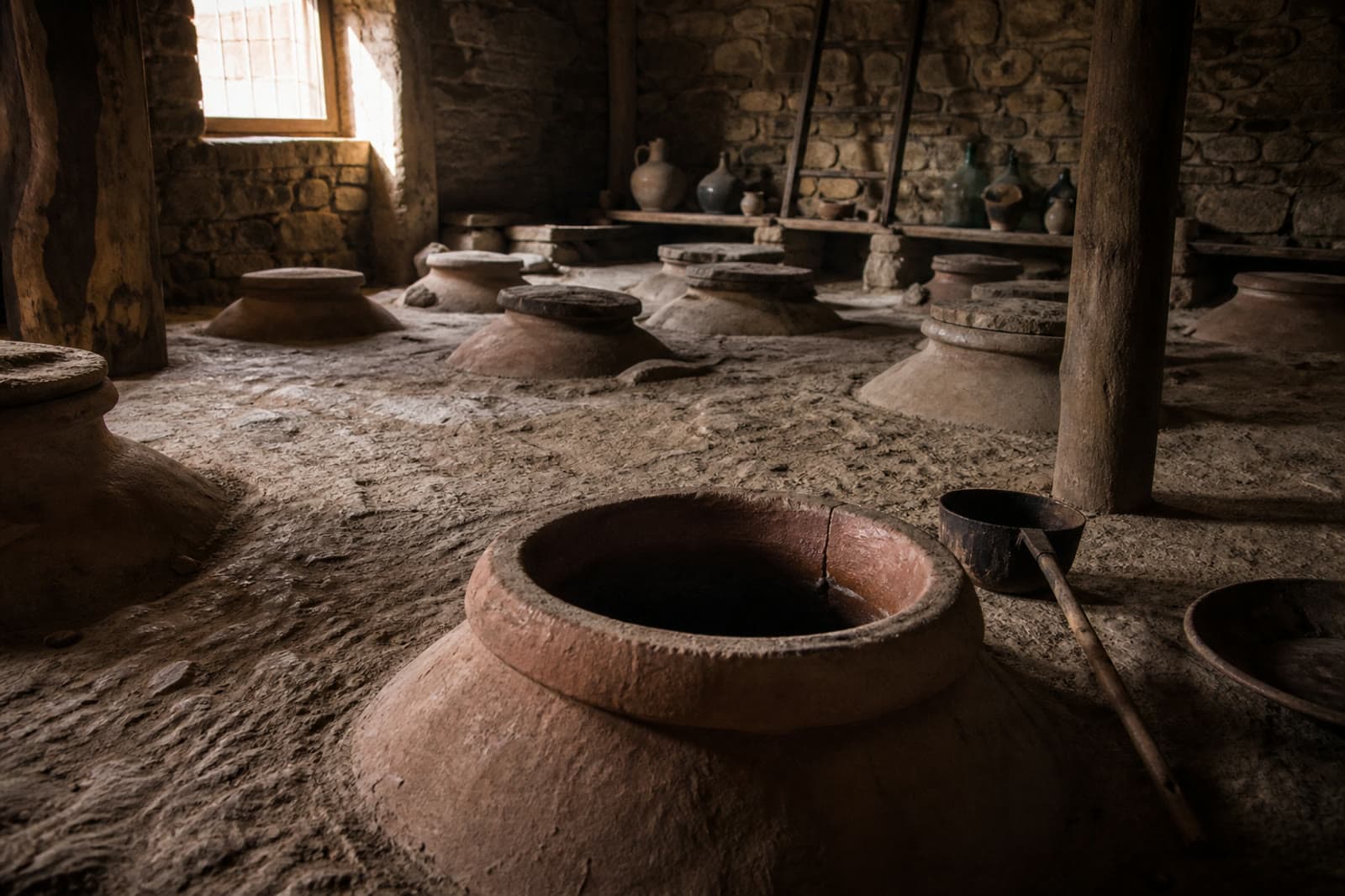
A qvevri is a large egg-shaped clay vessel buried in the ground up to its neck. The surrounding earth naturally regulates its temperature — no electrical cooling, no external control. Georgian winemaking literally happens underground.
This method is at least 8,000 years old. Georgia is one of the oldest winemaking countries in the world, and it was here that people first fermented grape juice in clay vessels. In 2013, UNESCO added traditional Georgian winemaking in qvevri to its Intangible Cultural Heritage list.
The defining feature of qvevri winemaking is extended skin contact. Juice ferments alongside grape skins, seeds, and stems for weeks or even months. This is why amber wines develop their characteristic golden hue and rich tannin structure — a rare quality for a white wine.
Modern qvevri are still made by hand. Each vessel is shaped spirally from the bottom up, then fired and lined with a thin layer of beeswax. That is the only "additive" in the entire process — no commercial yeasts, no sulphur, no fining agents.
In our catalog, qvevri wines occupy a special place. We work with small producers for whom the qvevri is not a marketing tool but the only method they know. Their wines carry scents of dried fruit, walnut shell, earth, and something that words struggle to capture. They need to be tasted.